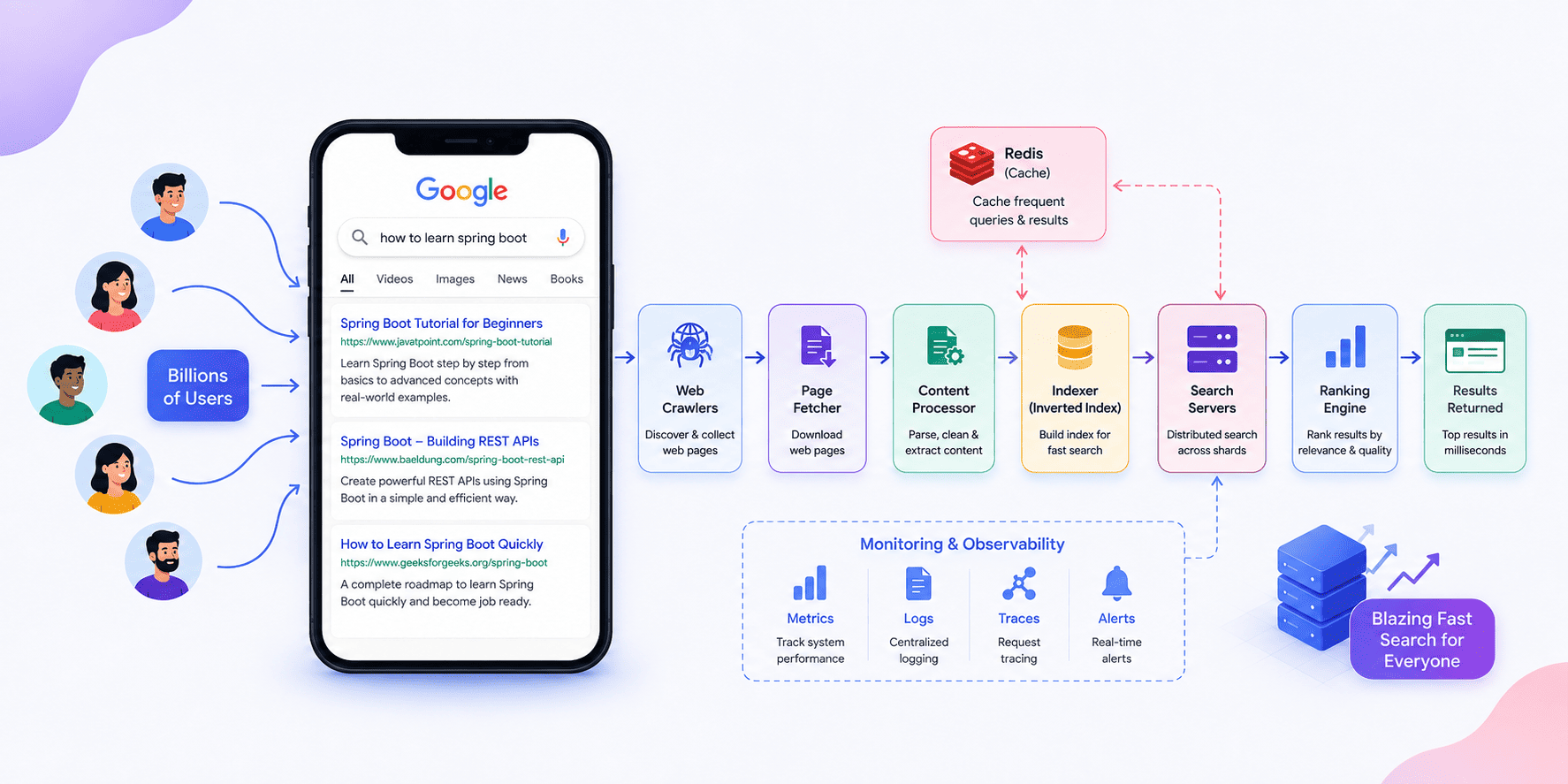
Have you ever wondered what actually happens when you search something on Google?
You type:
How to learn Spring Bootand within a fraction of a second, Google gives you millions of results.
It feels almost instant.
But think about the problem for a moment.
The internet contains billions of pages.
Google needs to:
- find relevant pages
- understand your query
- rank the results
- check freshness
- handle spelling
- personalize results
- return the best results
And it has to do all of this while handling a huge number of searches.
So the obvious question is:
How can a search engine search billions of web pages and still return results so quickly?
The answer is not:
"Google searches the entire internet every time you press Enter."
That would be far too slow.
The real trick is preprocessing, indexing, distributed systems, caching, and efficient ranking.
Let's understand it step by step.
🧠 1. Google Doesn't Search the Entire Internet When You Search
This is probably the most important concept.
Imagine Google stored billions of web pages.
If every search required:
User Query↓
Search Billions of Pages
↓
Find Matching Pages
↓
Rank Them
↓
Return Results
the response would take far too long.
Instead, search engines build an index before users even search.
Think about a book.
A book may have 1,000 pages.
If you want to find the topic "Java", you don't read all 1,000 pages.
You open the index.
Java → Page 20, 45, 87Spring → Page 120, 230
Database → Page 300, 450
Google uses the same basic idea, but at an enormous scale.
Instead of searching every web page:
Query↓
Search Index
↓
Relevant Documents
↓
Ranking
↓
Results
That's one of the biggest reasons search can be fast.
🌐 2. First, Google Has to Discover Web Pages
Before a page can appear in search results, the search engine needs to know that the page exists.
This is where web crawling comes in.
Conceptually:
Web Pages↓
Crawler
↓
Discover URLs
↓
Download Pages
↓
Process Content
↓
Build Index
A crawler follows links from one page to another.
For example:
Page A↓
Page B
↓
Page C
↓
Page D
If Page A contains a link to Page B, the crawler can discover Page B.
Over time, the search engine builds a huge collection of discovered pages.
But crawling alone isn't enough.
The content needs to be processed and organized.
📦 3. The Search Engine Builds an Index
Suppose the internet contains these pages:
Document1 → Java Spring Boot Tutorial Document
2 → Spring Boot REST API Guide Document
3 → Python Machine Learning Guide
Now imagine someone searches:
Spring BootInstead of scanning every document, the search engine can maintain an index like:
Spring↓
Doc 1 Doc 2 Boot
↓
Doc 1 Doc 2 Python
↓
Doc 3
This is similar to an inverted index.
The important idea is:
Instead of document → words, we organize words → documents.
So when the user searches:
Spring Bootthe system can quickly find:
Doc 1 Doc 2rather than scanning the entire document collection.
⚡ 4. Why Is an Inverted Index So Powerful?
Let's imagine we have:
1 Billion Documentsand a user searches:
JavaA naive approach would be:
Check Document 1 Check Document 2 Check Document 3 ... Check Document 1,000,000,000That's obviously expensive.
With an inverted index:
"Java"↓
[Doc 10, Doc 21, Doc 52, Doc 100, ...]
The system immediately gets a candidate list.
Then it can rank those candidates.
So the flow becomes:
Query↓
Index Lookup
↓
Candidate Documents
↓
Ranking
↓
Top Results
This dramatically reduces the amount of work that needs to happen during the user's request.
🧩 5. Search Is More Than Just Finding a Word
Now suppose you search:
best Java frameworkThe search engine can't simply look for pages containing these three words.
There may be millions of pages containing:
Java frameworkBut not all of them are useful.
The search engine needs to understand things like:
- query meaning
- relevance
- page quality
- freshness
- language
- location
- context
So after retrieving candidate pages, the system needs to rank them.
Conceptually:
User Query↓
Find Candidates
↓
Calculate Relevance
↓
Rank Candidates
↓
Return Top Results
This ranking step is one of the most important parts of a search engine.
🧠 6. Ranking Is the Real Challenge
Imagine Google finds:
10 Million matching pagesIt can't show all of them.
It needs to choose the best ones.
Conceptually, each result can receive a score:
Result Score = Relevance + Quality + Freshness + Other SignalsThis is only a simplified representation.
Real search ranking is far more sophisticated.
The important system-design idea is:
First reduce the search space, then spend more computation on the most promising candidates.
For example:
1 Billion Pages↓
Index
↓
1 Million Candidates
↓
Ranking
↓
10,000 Strong Candidates ↓ Top 10 Results
The system doesn't need to perform expensive processing on every page.
🚀 7. Google Doesn't Run This on One Server
Now imagine:
1 Search RequestOne server might handle it.
But what about millions of searches?
One machine can't handle everything.
So large-scale search systems use distributed infrastructure.
Conceptually:
                         ┌──────────────┐
                         │    Users     │
                         └──────┬───────┘
                                │
                                ▼
                       ┌─────────────────┐
                       │  Load Balancer  │
                       └────────┬────────┘
                                │
                ┌───────────────┼───────────────┐
                │               │               │
                ▼               ▼               ▼
        ┌──────────────┐ ┌──────────────┐ ┌──────────────┐
        │  Search 1    │ │  Search 2    │ │  Search 3    │
        │    Server    │ │    Server    │ │    Server    │
        └──────────────┘ └──────────────┘ └──────────────┘
Traffic is distributed across many machines.
If traffic increases:
100 Servers ↓ 500 Servers ↓ 1,000 ServersMore capacity can be added horizontally.
This is one of the fundamental principles of large-scale system design.
📊 8. The Search Index Is Also Distributed
Remember our inverted index?
It could be enormous.
We can't necessarily store the entire index on one machine.
So the index can be distributed across multiple machines or partitions.
Conceptually:
                         ┌──────────────────┐
                         │   Search Index   │
                         └────────┬─────────┘
                                  │
                  ┌───────────────┼───────────────┐
                  │               │               │
                  ▼               ▼               ▼
          ┌──────────────┐ ┌──────────────┐ ┌──────────────┐
          │    Shard 1   │ │    Shard 2   │ │    Shard 3   │
          └──────┬───────┘ └──────┬───────┘ └──────┬───────┘
                 │                │                │
                 ▼                ▼                ▼
          ┌──────────────┐ ┌──────────────┐ ┌──────────────┐
          │  Index Data  │ │  Index Data  │ │  Index Data  │
          └──────────────┘ └──────────────┘ └──────────────┘
Now a query can be processed across multiple shards.
For example:
                         ┌──────────────┐
                         │    Query     │
                         └──────┬───────┘
                                │
                                ▼
                    ┌──────────────────────┐
                    │  Search Coordinator  │
                    └──────────┬───────────┘
                               │
              ┌────────────────┼────────────────┐
              │                │                │
              ▼                ▼                ▼
       ┌────────────┐   ┌────────────┐   ┌────────────┐
       │   Shard 1  │   │   Shard 2  │   │   Shard 3  │
       └─────┬──────┘   └─────┬──────┘   └─────┬──────┘
             │                │                │
             ▼                ▼                ▼
       ┌────────────┐   ┌────────────┐   ┌────────────┐
       │  Results 1 │   │  Results 2 │   │  Results 3 │
       └─────┬──────┘   └─────┬──────┘   └─────┬──────┘
             │                │                │
             └────────────────┼────────────────┘
                              │
                              ▼
                    ┌──────────────────┐
                    │  Merge Results   │
                    └────────┬─────────┘
                             │
                             ▼
                    ┌──────────────────┐
                    │      Rank        │
                    └────────┬─────────┘
                             │
                             ▼
                    ┌──────────────────┐
                    │   Top Results    │
                    └──────────────────┘
This is called distributed search.
🔄 9. Parallel Processing Makes Search Faster
Suppose searching the entire index takes:
900 mson one machine.
Instead, imagine the work is divided:
Shard 1 → 100 msShard 2 → 120 ms
Shard 3 → 90 ms
Shard 4 → 110 ms
These operations can run in parallel.
                         ┌──────────────┐
                         │    Query     │
                         └──────┬───────┘
                                │
                                ▼
                       ┌────────────────┐
                       │   Coordinator  │
                       └───────┬────────┘
                               │
               ┌───────────────┼───────────────┐
               │               │               │
               ▼               ▼               ▼
        ┌────────────┐  ┌────────────┐  ┌────────────┐
        │   Shard 1  │  │   Shard 2  │  │   Shard 3  │
        │   100 ms   │  │   120 ms   │  │    90 ms   │
        └──────┬─────┘  └──────┬─────┘  └──────┬─────┘
               │               │               │
               └───────────────┼───────────────┘
                               │
                               ▼
                     ┌──────────────────┐
                     │   Merge Results  │
                     └──────────────────┘
The total latency is much closer to the slowest required shard operation than the sum of every operation.
That's the power of parallelism.
⚡ 10. Caching Makes Popular Searches Even Faster
Now think about common searches.
Millions of people may search for things like:
weather YouTube Facebook football scores JavaIf the same query is repeatedly requested, why perform the same expensive work every time?
A cache can help.
Conceptually:
                         ┌──────────────┐
                         │  User Query  │
                         └──────┬───────┘
                                │
                                ▼
                        ┌──────────────┐
                        │    Cache     │
                        └──────┬───────┘
                               │
                    ┌──────────┴──────────┐
                    │                     │
                  Cache Hit            Cache Miss
                    │                     │
                    ▼                     ▼
             ┌──────────────┐     ┌──────────────┐
             │    Result    │     │Search System │
             └──────────────┘     └──────┬───────┘
                                         │
                                         ▼
                                  ┌──────────────┐
                                  │    Cache     │
                                  │   (Update)   │
                                  └──────┬───────┘
                                         │
                                         ▼
                                  ┌──────────────┐
                                  │    Result    │
                                  └──────────────┘
For example:
"Java Spring Boot"↓
Cached Result
The next request may be able to retrieve the result much faster.
Caching can reduce:
- CPU usage
- database/index load
- repeated computation
- response latency
But caching search results isn't always simple because results can change.
So cache expiration and invalidation become important.
🔥 11. Hot Queries Create a Different Problem
Suppose one query suddenly becomes extremely popular.
For example:
"World Cup Final"Millions of users search for it within a short period.
Now that query becomes a hot key.
Without proper design:
Millions of Requests↓
One Cache Entry
↓
One Backend
↓
Potential Bottleneck
Large-scale systems need to distribute this load.
Possible techniques include:
- replicated cache entries
- request coalescing
- multiple backend instances
- load balancing
- caching
- rate limiting
The general lesson is:
Even a system with huge overall capacity can struggle when millions of requests target the same piece of data.
🔎 12. Search Suggestions Need to Be Fast Too
You've probably noticed that Google starts suggesting queries while you type:
jav↓
java java tutorial java interview java spring boot
This is another system that needs low latency.
A simplified architecture could look like:
User Types↓
Suggestion Service
↓
Suggestion Cache / Index
↓
Top Suggestions
The system doesn't want to perform expensive full search processing for every character.
Instead, suggestions can be precomputed or served from highly optimized data structures.
So when you type:
javthe system can quickly return popular or relevant completions.
🌍 13. Global Users Need Global Infrastructure
Google has users all over the world.
If every request had to travel to one location:
          India ───────┐
                       │
          USA ─────────┼──────→ ┌──────────────────┐
                       │        │   One Data       │
       Europe ─────────┘        │     Center       │
                                └──────────────────┘
network latency would become a problem.
Large-scale systems therefore use geographically distributed infrastructure.
Conceptually:
                           ┌──────────────────┐
                           │  Global Users    │
                           └────────┬─────────┘
                                    │
                                    ▼
                     ┌──────────────────────────┐
                     │  Global Traffic Routing  │
                     └────────────┬─────────────┘
                                  │
                 ┌────────────────┼────────────────┐
                 │                │                │
                 ▼                ▼                ▼
          ┌─────────────┐  ┌─────────────┐  ┌─────────────┐
          │  Region A   │  │  Region B   │  │  Region C   │
          └──────┬──────┘  └──────┬──────┘  └──────┬──────┘
                 │                │                │
                 ▼                ▼                ▼
          ┌─────────────┐  ┌─────────────┐  ┌─────────────┐
          │ Search      │  │ Search      │  │ Search      │
          │ Infra       │  │ Infra       │  │ Infra       │
          └─────────────┘  └─────────────┘  └─────────────┘
Requests can be routed toward suitable infrastructure.
This helps reduce network latency and improves availability.
🗄 14. Search Results Are Not Usually Generated From a Traditional Database Query
This is another important distinction.
A beginner might imagine:
SELECT * FROM webpages WHERE content LIKE '%spring boot%';That would be extremely expensive at web scale.
Search engines typically rely on specialized indexing structures rather than treating the entire web as one giant SQL table.
The architecture is closer to:
Query↓
Query Processing
↓
Search Index
↓
Candidate Retrieval
↓
Ranking
↓
Results
This is why search indexes are so important.
🧠 15. Query Processing Happens Before Search
When you type:
how to learn java quicklythe system doesn't necessarily treat it as a simple string.
It may need to understand:
- individual terms
- language
- spelling
- intent
- context
- synonyms
- query meaning
A simplified flow is:
Raw Query↓
Query Processing
↓
Understanding / Normalization
↓
Search Index
↓
Candidate Retrieval
For example, a misspelled query might be corrected before the search is executed.
This improves both relevance and user experience.
🤖 16. Modern Search Also Uses Machine Learning
Search ranking isn't just about matching keywords.
Modern search systems use machine-learning techniques to understand queries and documents better.
A simplified architecture could be:
User Query↓
Query Understanding
↓
Candidate Retrieval
↓
Ranking Models
↓
Final Results
Machine learning can help determine which results are more likely to satisfy the user's intent.
But there's an important system-design principle here:
You don't want to run the most expensive model against every page on the internet.
Instead:
Billions of Pages↓
Fast Retrieval
↓
Smaller Candidate Set
↓
More Expensive Ranking
↓
Top Results
This is often called a multi-stage retrieval and ranking architecture.
🧯 17. What Happens When a Search Server Fails?
At Google's scale, hardware failures are expected.
Suppose:
Search Server 12↓
FAILED
The system shouldn't completely stop working.
Other replicas or instances can continue serving requests.
Conceptually:
                         ┌──────────────┐
                         │  Search Shard │
                         └──────┬───────┘
                                │
                 ┌──────────────┼──────────────┐
                 │              │              │
                 ▼              ▼              ▼
            ┌────────┐     ┌────────┐     ┌────────┐
            │   R1   │     │   R2   │     │   R3   │
            │Replica │     │Replica │     │Replica │
            └────────┘     └────────┘     └────────┘
If one replica fails:
                    ┌──────────────────┐
                    │    Search Shard   │
                    └────────┬─────────┘
                             │
              ┌──────────────┼──────────────┐
              │              │              │
              ▼              ▼              ▼
        ┌──────────┐   ┌──────────┐   ┌──────────┐
        │    R1    │   │    R2    │   │    R3    │
        │ ❌ FAILED │   │ ✅ HEALTHY│   │ ✅ HEALTHY│
        └──────────┘   └──────────┘   └──────────┘
the system can continue using healthy replicas.
This is the idea of redundancy and fault tolerance.
📈 18. Observability Is Critical
Imagine a search request suddenly becomes slow.
Engineers need to know:
Is the network slow?↓
Is query processing slow?
↓
Is index retrieval slow?
↓
Is one shard overloaded?
↓
Is ranking taking longer?
↓
Is a cache failing?
So a large distributed search system needs extensive monitoring.
Important metrics can include:
Query Latency Queries / Second Error Rate Cache Hit Rate Shard Latency CPU Usage Memory Usage Queue SizeFor example:
Shard 7 Latency↓
Increasing
↓
Shard overloaded
↓
Investigate / Rebalance
Observability is what allows engineers to find bottlenecks before they become major incidents.
🧩 19. Putting Everything Together
Now let's combine the major pieces.
A simplified Google-scale search architecture could look like this:
                              ┌──────────────┐
                              │     USER     │
                              └──────┬───────┘
                                     │
                                     ▼
                            ┌─────────────────┐
                            │  Load Balancer  │
                            └────────┬────────┘
                                     │
                                     ▼
                            ┌─────────────────┐
                            │ Query Processing│
                            └────────┬────────┘
                                     │
                                     ▼
                       ┌────────────────────────┐
                       │  Search Coordinator    │
                       └────────────┬───────────┘
                                    │
                    ┌───────────────┼───────────────┐
                    │               │               │
                    ▼               ▼               ▼
             ┌────────────┐  ┌────────────┐  ┌────────────┐
             │   Shard 1  │  │   Shard 2  │  │   Shard 3  │
             └─────┬──────┘  └─────┬──────┘  └─────┬──────┘
                   │               │               │
                   ▼               ▼               ▼
             ┌────────────┐  ┌────────────┐  ┌────────────┐
             │ Candidate  │  │ Candidate  │  │ Candidate  │
             │  Results   │  │  Results   │  │  Results   │
             └─────┬──────┘  └─────┬──────┘  └─────┬──────┘
                   │               │               │
                   └───────────────┼───────────────┘
                                   │
                                   ▼
                         ┌────────────────────┐
                         │ Result Aggregation │
                         └──────────┬─────────┘
                                    │
                                    ▼
                            ┌──────────────┐
                            │    Ranking   │
                            └──────┬───────┘
                                   │
                                   ▼
                            ┌──────────────┐
                            │ Top Results  │
                            └──────┬───────┘
                                   │
                                   ▼
                              ┌──────────┐
                              │   USER   │
                              └──────────┘
And around the system:
                         ┌──────────────────────┐
                         │    Search System     │
                         └──────────┬───────────┘
                                    │
                  ┌─────────────────┴─────────────────┐
                  │                                   │
                  ▼                                   ▼
        ┌──────────────────────┐          ┌──────────────────────┐
        │     Cache Layer      │          │      Monitoring      │
        │                      │          │ Metrics + Logs +     │
        │                      │          │       Traces         │
        └──────────────────────┘          └──────────────────────┘
Meanwhile, behind the scenes:
Web↓
Crawling
↓
Processing
↓
Indexing
↓
Distributed Search Index
So the complete picture becomes:
INTERNET↓
Crawlers
↓
Page Processing
↓
Indexing
↓
Distributed Index
↑
│
USER → Query → Search → Ranking → Results
This separation is extremely important.
Crawling and indexing happen before the search request.
The user's request mainly needs to perform:
Query↓
Retrieve
↓
Rank
↓
Return
That's how the system can respond quickly.
🎯 So, How Does Google Search Return Results So Fast?
There isn't one magic technology responsible for Google's search speed.
It's the combination of several ideas:
Precomputed Index + Inverted Index + Distributed Search + Parallel Processing + Caching + Horizontal Scaling + Efficient Ranking + Machine Learning + Replication + Global InfrastructureEach solves a different problem.
Web Crawling
Discovers pages across the internet.
Indexing
Organizes information so it can be searched efficiently.
Inverted Index
Maps terms to documents instead of scanning every document.
Distributed Search
Splits huge search indexes across multiple machines.
Parallel Processing
Searches multiple partitions simultaneously.
Caching
Avoids repeating expensive work for frequently requested data.
Ranking
Selects the most relevant results from the candidate set.
Horizontal Scaling
Allows more servers to handle increasing traffic.
Replication
Keeps the system available when individual machines fail.
Global Infrastructure
Reduces latency for users around the world.
💡 The Biggest Lesson
The biggest misconception about search engines is:
"Google searches the entire internet whenever I press Search."
That's not how a scalable search system should work.
The expensive work happens before the user searches.
Crawl↓
Process
↓
Index
↓
Store
Then when the user searches:
Query↓
Fast Index Lookup
↓
Candidate Retrieval
↓
Ranking
↓
Results
Instead of:
Search Billions of Pages↓
Read Everything
↓
Compare Everything
↓
Return Result
we do:
Search Index↓
Find Relevant Candidates
↓
Rank Only Those Candidates
↓
Return Top Results
And that's the real secret behind building a fast search system at massive scale.
The lesson isn't only useful for Google.
The same thinking can be applied when building your own:
- product search
- job portal search
- e-commerce search
- document search
- log search
- knowledge-base search
Whenever you have millions of records but need millisecond-level search, the architecture matters far more than simply throwing more CPU at the problem.
Fast systems don't always do more work faster. Sometimes, they are fast because they avoid doing unnecessary work in the first place.