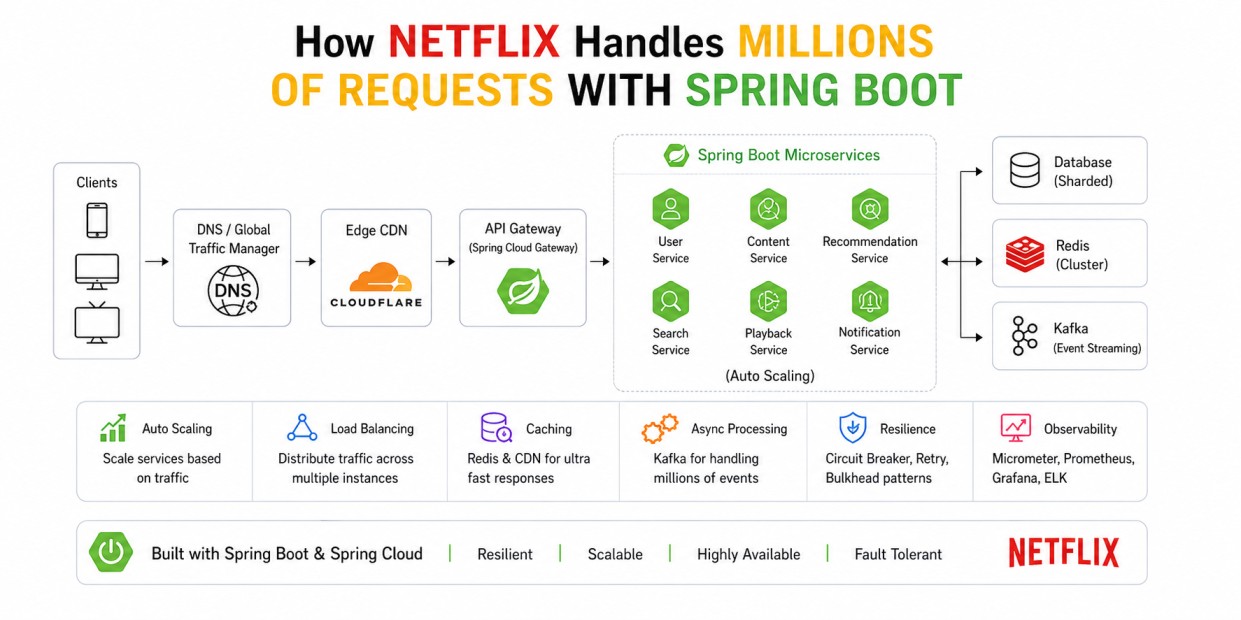
Many developers think scaling an API is simply about buying a bigger server.
More traffic?
Just increase the server size.
That approach may work when your application is small.
But what happens when your application has millions of users, hundreds of APIs, and thousands of requests arriving at the same time?
At that point, the problem is no longer:
“How powerful is my server?”
The real question becomes:
“How can I distribute the load across the entire system?”
This is where the architecture used by companies like Netflix becomes interesting.
Netflix has historically open-sourced and used technologies around service discovery, load balancing, fault tolerance, and cloud-native systems. Today, the exact Netflix stack is much more sophisticated than simply putting Spring Boot behind a few tools, but the architectural ideas are extremely useful for Spring Boot developers.
So let's understand these ideas in a way that you can actually apply to your own Spring Boot applications.
🧠 1. Don't Put Everything Inside One Application
Let's start with a simple Spring Boot application.
Imagine we build a streaming platform as a single application:
                         Client
                           │
                           ↓
              ┌────────────────────────┐
              │      Spring Boot       │
              │      Application       │
              └───────────┬────────────┘
                          │
             ┌────────────┼────────────┐
             ↓            ↓            ↓
          Users         Videos       Payments
                           │
                           ↓
                       Database
Initially, this looks perfectly fine.
But as the application grows, problems start appearing.
Suppose the video service suddenly receives 10 times more traffic because a new movie was released.
What happens?
You have to scale the entire application, even though only the video functionality needs more resources.
That's one of the biggest problems with a monolith.
Instead, we can split the application into smaller services:
                         Client
                           │
                           ↓
              ┌────────────────────────┐
              │      Spring Boot       │
              │      Application       │
              └───────────┬────────────┘
                          │
             ┌────────────┼────────────┐
             ↓            ↓            ↓
          Users         Videos       Payments
                           │
                           ↓
                       Database
Now each service can be scaled independently.
If Video Service receives heavy traffic:
We don't need to create three copies of the entire application.
We only scale the service that actually needs more capacity.
That's the real benefit of microservices.
It's not simply:
“Microservices are modern.”
It's:
“Different parts of the system can scale independently.”
⚡ 2. Put an API Gateway in Front of Your Services
Now imagine you have 50 microservices.
Should the mobile application know the IP address of every service?
Something like this?
Mobile App↓
user-service:8081
video-service:8082
payment-service:8083
recommendation-service:8084 ...
Definitely not.
Instead, we put an API Gateway in front.
                         Client
                           │
                           ↓
                    ┌──────────────┐
                    │  API Gateway │
                    └──────┬───────┘
                           │
              ┌────────────┼────────────┐
              ↓            ↓            ↓
       User Service   Video Service   Payment Service
Now the client only needs to know one entry point.
The gateway decides where the request should go.
For example:
GET /users/101↓
API Gateway
↓
User Service
And:
GET /movies/123↓
API Gateway
↓
Video Service
The gateway can also become the place for common concerns such as:
- authentication
- authorization
- routing
- rate limiting
- request filtering
- logging
This keeps individual microservices focused on their actual business logic.
📦 3. Service Discovery: How Does One Service Find Another?
Here's another problem.
Suppose User Service needs to call Recommendation Service.
Where is Recommendation Service running?
Maybe:
10.0.0.21Tomorrow it gets restarted and its IP becomes:
10.0.0.45If User Service has the IP hardcoded, things break.
That's why distributed systems use service discovery.
The basic idea is simple.
Services register themselves:
User Service↓
Service Registry Video Service
↓
Service Registry Recommendation Service
↓
Service Registry
When one service needs another:
User Service↓
"Where is Recommendation Service?"
↓
Service Registry
↓
"Here are the available instances."
Historically, Netflix open-sourced Eureka for service registration and discovery.
In a modern Spring Boot system, the exact discovery mechanism may be different depending on your infrastructure.
The important concept is:
Services should not need to know the physical location of every other service.
🔁 4. One Service Should Have Multiple Instances
Now imagine Video Service is receiving:
10,000 requests/secondOne server may not be enough.
So instead of running:
we run multiple instances:
                    Video Service
                         │
                         ↓
              ┌──────────┼──────────┐
              ↓          ↓          ↓
         Instance 1  Instance 2  Instance 3
Now the incoming requests can be distributed:
Request 1 → Instance 1Request 2 → Instance 2
Request 3 → Instance 3
Request 4 → Instance 1
This is load balancing.
If one instance becomes unhealthy, traffic can be redirected to healthy instances.
This is much better than depending on one powerful server.
🧯 5. What Happens When Another Service Fails?
This is one of the most important concepts in microservices.
Suppose we have:
Order Service↓
Payment Service
↓
Notification Service
Now Notification Service becomes slow.
What happens if Order Service keeps waiting for it?
Requests start piling up.
Eventually:
Notification Service↓
Slow
↓
Payment Service
↓
Slow
↓
Order Service
↓
Slow
One small failure can start affecting the entire system.
This is called a cascading failure.
A common solution is the Circuit Breaker pattern.
The idea is simple:
Service is healthy↓
Requests are allowed
↓
Service starts failing
↓
Failure threshold reached
↓
Circuit OPEN
↓
Stop sending requests temporarily
↓
Return fallback / controlled error
Netflix's Hystrix was historically designed around latency and fault tolerance for distributed systems and provided circuit-breaker and isolation mechanisms.
The important lesson is not the library name.
The lesson is:
A failure in one service should not bring down the entire system.
🗄 6. Don't Hit the Database for Everything
Imagine your homepage receives:
100,000 requestsAnd every request executes:
SELECT * FROM movies;Your database is going to have a very bad day. 😄
Not every piece of data needs to come directly from the database.
For frequently requested data, we can use a cache.
                         Client
                           │
                           ↓
                           API
                           │
                           ↓
                         Cache
                           │
                           ↓
                       Database
Request Flow
                         │
                         ↓
                    Check Cache
                         │
                         ↓
                     Data found?
                      /        \
                    Yes         No
                     ↓           ↓
              Return Data     Database
                                 │
                                 ↓
                               Cache
                                 │
                                 ↓
                              Return
For example, movie metadata that doesn't change every second could be cached.
This reduces:
- database load
- response time
- unnecessary network calls
Technologies such as Redis are commonly used for distributed caching in modern Spring Boot architectures.
The key idea is:
If the same data is requested again and again, don't calculate or fetch it again and again if you don't have to.
📈 7. Horizontal Scaling: Add More Machines
There are two common ways to scale.
Vertical Scaling
Make one machine bigger:
4 CPU↓
16 CPU
↓
32 CPU
This works, but there is a limit.
Horizontal Scaling
Add more instances:
Instance 1Instance 2
Instance 3
Instance 4
Instance 5
This is extremely useful for cloud-native systems.
When traffic increases:
Normal Traffic↓
3 Instances
During a traffic spike:
High Traffic↓
10 Instances
And when traffic drops:
Low Traffic↓
3 Instances
This is where cloud infrastructure and auto-scaling become extremely powerful.
Instead of keeping 20 expensive servers running all day, the infrastructure can adjust capacity according to demand.
🔄 8. Don't Make Every Operation Synchronous
Here's a common mistake.
Suppose a user places an order.
After saving the order, we need to:
- send email
- send notification
- update analytics
- generate invoice
- update recommendation data
Should the API wait for all of these?
That's unnecessary.
The user mainly cares about:
“Was my order created?”
So we can move background work to asynchronous processing.
                         API
                          │
                          ↓
                     Save Order
                          │
                          ↓
                       Response
                          │
                          ↓
                       Message
                          │
                ┌─────────┼─────────┐
                ↓         ↓         ↓
              Email    Analytics  Notification
Technologies such as Kafka are often used for this kind of event-driven architecture.
Now the API doesn't have to wait for every background operation to finish.
This makes the application more responsive and helps it absorb traffic spikes.
🌍 9. One Server Is Not Enough — Think About Regions
Now let's think globally.
If your application is running only in one location:
Users↓
Single Region
↓
Application
What happens if that region has a major failure?
Your entire application could become unavailable.
Large-scale systems therefore think about:
                    Global Users
                         │
                         ↓
              Traffic Management
                    /         \
                   ↓           ↓
              Region A       Region B
                   │           │
                   ↓           ↓
               Services     Services
This gives the system more resilience.
If one location experiences a major problem, traffic can potentially be shifted toward healthy infrastructure.
This is one of the reasons cloud-native architecture is so important for globally distributed applications.
📊 10. You Cannot Scale What You Cannot Observe
Imagine your application is receiving millions of requests.
But you don't know:
- which API is slow
- which service is failing
- how many requests are returning 500
- where latency is increasing
- whether the database is overloaded
Then you're basically flying blind.
That's why observability is critical.
You want visibility into things like:
Request Count Error Rate Response Time CPU Usage Memory Usage Database Connections Cache Hit RateFor example:
Tools such as Prometheus and Grafana are commonly used in Spring Boot environments for metrics and visualization.
The goal isn't to create pretty dashboards.
The goal is:
Know that something is wrong before your users tell you.
🧩 11. The Real Architecture Is a Combination of All These Ideas
Now let's put everything together.
A simplified Netflix-style architecture could look like this: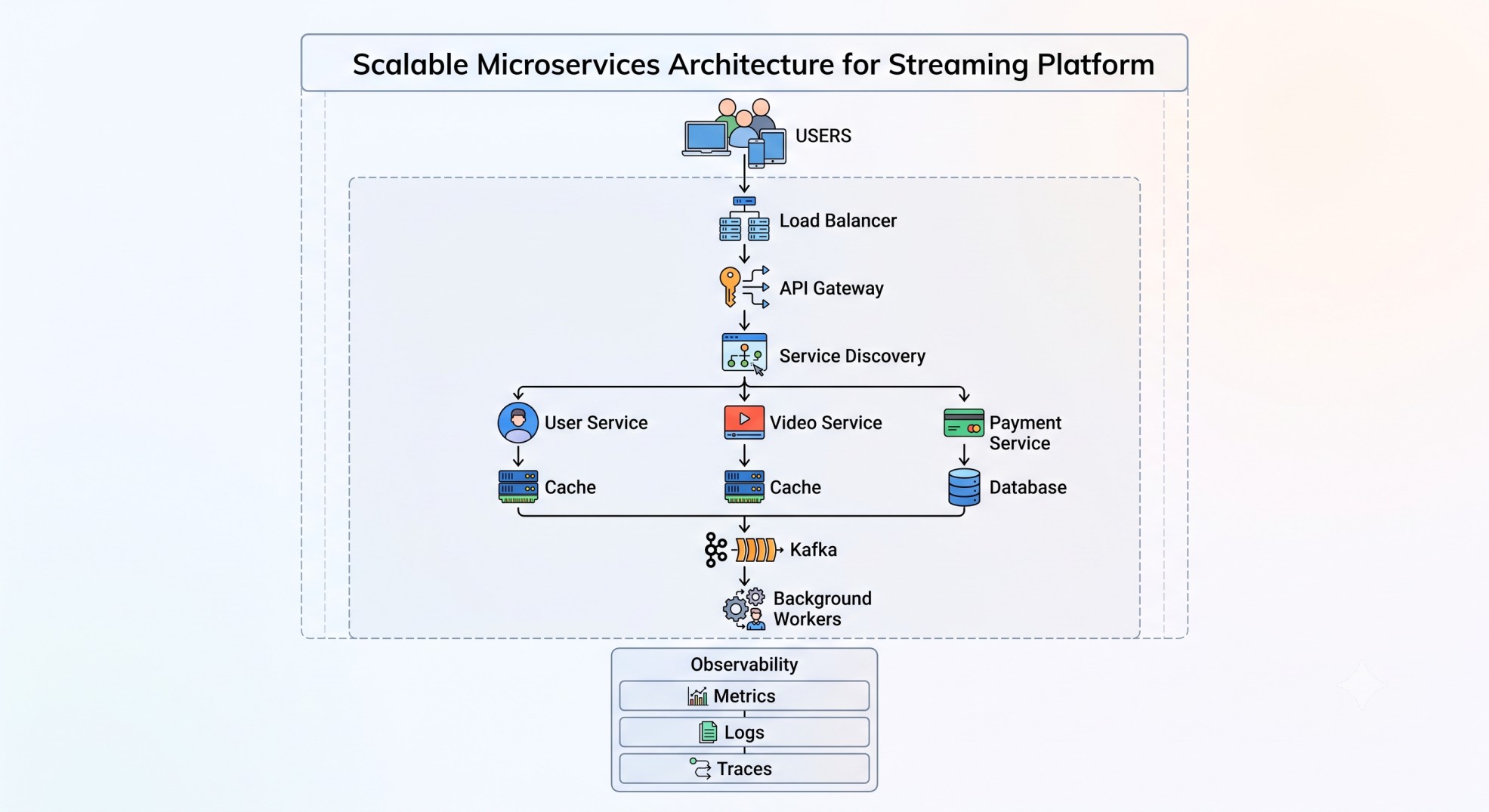
Every component solves a different problem.
Microservices → independent scaling
API Gateway → centralized entry point
Service Discovery → services can find each other
Load Balancing → distribute traffic
Caching → reduce database pressure
Circuit Breaker → prevent cascading failures
Async Processing → don't block API requests
Horizontal Scaling → handle traffic growth
Observability → understand what is happening
🎯 So, What's the Actual Secret?
There is no single technology that magically allows an application to handle millions of requests.
It's not:
“Use Spring Boot and you're done.”
And it's definitely not:
“Buy a bigger server.”
Scalability comes from combining multiple architectural ideas.
A request might travel through something like:
User↓
Load Balancer
↓
API Gateway
↓
Service
↓
Cache
↓
Database
And when some work doesn't need to happen immediately:
Service↓
Kafka / Message Broker
↓
Background Consumer
If a service becomes unhealthy:
Circuit Breaker↓
Protect the system
And when traffic increases:
3 Instances↓
10 Instances
↓
50 Instances
That's the real meaning of scaling.
💡 Key Takeaways
If you are building a Spring Boot application today, you don't need Netflix-level infrastructure from day one.
Start simple.
Then introduce complexity only when the problem requires it.
A good evolution might look like:
The most important lesson is this:
Scalable systems are not built by making one server stronger. They are built by designing the system so that work can be distributed, failures can be isolated, and capacity can grow when traffic grows.