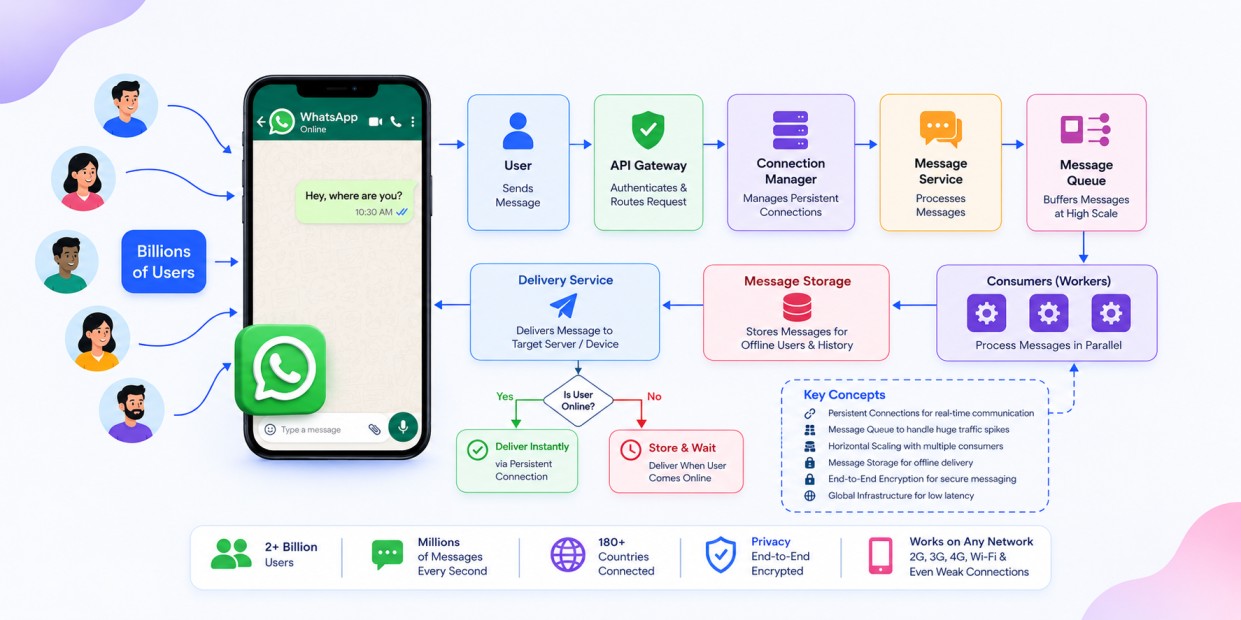
Have you ever thought about what actually happens when you send a WhatsApp message?
You type:
"Hey, where are you?"You press Send.
And within seconds, the other person receives it.
It feels simple.
But behind that tiny Send button, there is a distributed system handling:
millions of connected users
millions of messages
unreliable mobile networks
offline users
message delivery
retries
acknowledgements
message ordering
encryption
multiple devices
Now imagine millions of people sending messages at exactly the same time.
A simple architecture like this:
User↓
Server
↓
Database
↓
Receiver
would quickly become difficult to scale.
So how can a messaging system deliver messages quickly while remaining reliable?
Let's understand it step by step.
🧠 1. What Happens When You Press Send?
Let's start with the simplest possible flow.
Suppose User A sends a message to User B.
User A↓
"Hello"
↓
Messaging Server
↓
User B
The first important thing is that User A doesn't need to know where User B's device is.
The client simply sends the message to the messaging backend.
Conceptually:
User A↓
Connection / API
↓
Messaging Service
↓
User B
The backend is responsible for figuring out:
Where should this message go?
This becomes much more interesting when User B is offline.
We'll get to that shortly.
⚡ 2. Persistent Connections Make Messaging Fast
Imagine that every time you send a message, the mobile application creates a completely new connection:
Connect↓
Send message
↓
Disconnect
Doing this for every message would create unnecessary overhead.
Messaging applications generally benefit from maintaining a long-lived connection between the client and the backend.
Conceptually:
Mobile App │ │ Long-lived connection │ Messaging ServerWhen the connection is already established, sending another message doesn't require starting from scratch.
This can significantly reduce communication overhead and improve responsiveness.
Protocols such as WebSocket are commonly used for real-time applications, while large-scale messaging systems may use other optimized persistent-connection mechanisms depending on their architecture.
The important idea is:
Keep the communication channel available instead of rebuilding it for every message.
🌍 3. How Does the Server Know Where the User Is?
Now suppose User B is connected.
The system needs to know:
User B↓
Which server is currently handling this connection?
Imagine the messaging system has thousands of servers:
Server 1 Server 2 Server 3 Server 4 ... Server 10,000User B could be connected to any of them.
So we need some kind of connection/session mapping.
Conceptually:
User ID↓
Connection Mapping
↓
Server / Connection
For example:
user_101 → server_27 user_102 → server_45 user_103 → server_12This information can be maintained using distributed in-memory systems or other coordination mechanisms.
Now when User A sends a message to User B:
User A↓
Messaging Service
↓
Find User B's connection
↓
Server 45
↓
User B
That's much more efficient than asking every server:
"Do you have User B?"
📦 4. What Does a Message Actually Look Like?
A message isn't just a string.
The system needs metadata around it.
Conceptually, a message could contain:
{"messageId": "msg-98231",
"senderId": "user-101",
"receiverId": "user-202",
"conversationId": "chat-5001",
"timestamp": "2026-08-29T10:30:00",
"content": "Hello"
}
The exact structure used by a production messaging system will be much more sophisticated.
But the important fields are:
message ID
sender
receiver
conversation
timestamp
message content
delivery state
The message ID is particularly important.
Why?
Because networks are unreliable.
A message may be retried.
If the server receives the same message twice, it shouldn't create two messages.
This leads us to an important distributed-systems concept:
Idempotency.
🔄 5. What If the Same Message Is Sent Twice?
Imagine User A sends:
Message ID: msg-100The network becomes unstable.
The client doesn't know whether the server received it.
So it retries:
Message ID: msg-100Now the server receives the same message twice.
Without protection:
Hello HelloThe receiver could see duplicate messages.
Instead, the backend can use the message ID to detect duplicates:
msg-100↓
Already processed?
↓
Yes
↓
Don't create another message
This is a very common pattern in distributed systems.
The general rule is:
The same operation should be safe to process more than once.
📨 6. Message Queues Help Handle Traffic Spikes
Now imagine a huge event.
Millions of users are sending messages at the same time.
If every message immediately performs heavy processing:
Message↓
Database
↓
Notification
↓
Delivery
the system can become overloaded.
Instead, we can introduce a message broker or queue.
User ↓ Messaging Service ↓ Message Queue ↓ Message Consumers ↓ Delivery / StorageFor example:
                 Messaging Service
                        ↓
                      Kafka
                        ↓
              ┌─────────┼─────────┐
              ↓         ↓         ↓
          Consumer   Consumer   Consumer
              ↓         ↓         ↓
           Process    Process    Process
Now incoming traffic can be buffered and processed by multiple consumers.
This gives the system more flexibility during sudden traffic spikes.
The exact technology used by a production messaging platform may differ, but the architectural idea is extremely useful:
Separate message ingestion from downstream processing.
🚀 7. How Does the Message Reach the Receiver So Quickly?
Let's simplify the delivery process.
User A sends:
"Hello"The flow could look like:
User A↓
Messaging Server
↓
Find User B's connection
↓
Delivery Service
↓
User B's active connection
↓
User B
If User B is online, the message can be delivered immediately.
User A↓
Server
↓
User B
But what if User B isn't online?
That's where things get interesting.
📴 8. What Happens When the Receiver Is Offline?
Suppose User A sends a message while User B's phone is switched off.
We can't deliver it immediately.
So the system needs to know:
User B↓
Offline
The message must be retained until it can be delivered according to the system's delivery policy.
Conceptually:
                         User A
                            ↓
                    Messaging Server
                            ↓
                 Is User B online?
                       /        \
                    Yes          No
                     ↓            ↓
                  Deliver       Store
                                  ↓
                                Wait
                                  ↓
                         User B comes online
                                  ↓
                                Deliver
This is one of the fundamental requirements of a reliable messaging system.
The sender shouldn't have to stay online waiting for the receiver.
🗄 9. Where Are Messages Stored?
A messaging application may need to store information such as:
Conversation Messages Delivery status User information Device informationA simple relational design might look like:
USER----------------
id name
CONVERSATION
----------------
id created_at
MESSAGE
----------------
id
conversation_id
sender_id
content created_at
But at massive scale, one database isn't enough.
Imagine:
Millions of users↓
Billions of messages
↓
One database
The database would eventually become a bottleneck.
So we need to distribute the data.
📊 10. Database Sharding
Instead of storing everything on one database:
                    Database
                       ↓
              ┌────────┼────────┐
              ↓        ↓        ↓
             DB1      DB2      DB3
we can distribute data across multiple database partitions or shards.
For example, messages could be partitioned based on:
conversationIdConceptually:
Conversation 1 → Shard 1 Conversation 2 → Shard 2 Conversation 3 → Shard 3Now the workload is distributed.
This is called database sharding.
The exact partitioning strategy depends heavily on the workload.
For a messaging system, we also need to think carefully about:
message ordering
conversation locality
hot conversations
replication
failover
🔥 11. The Hot Conversation Problem
Here's an interesting scenario.
Imagine a normal group:
20 membersNo big deal.
But now imagine a huge public group with:
1,000,000 membersThousands of messages can arrive at the same time.
That conversation becomes a hot partition.
If all messages are sent to the same database shard or processing partition:
1 Million Messages ↓ One Partition ↓ BottleneckWe need to distribute the workload carefully.
Possible strategies include:
partitioning
multiple consumers
batching
asynchronous processing
distributed counters
workload-aware routing
This is a common system-design problem:
One extremely popular entity can become a bottleneck even when the overall system has plenty of capacity.
🔐 12. Encryption Is a Different Challenge
Messaging systems also need strong security.
In end-to-end encrypted systems, the basic goal is:
Sender↓
Encrypted Message
↓
Server
↓
Encrypted Message
↓
Receiver
The server may route and temporarily handle encrypted data without being able to read the message contents.
This is fundamentally different from a traditional application where the backend receives plaintext data and stores it directly.
End-to-end encryption introduces additional challenges around:
key management
device identity
multiple devices
message authentication
key rotation
secure recovery
So a large messaging system isn't only a scalability problem.
It's also a security and reliability problem.
🔁 13. How Do Delivery Receipts Work?
You've probably seen message states like:
✓✓✓
✓✓ Blue
Conceptually, these states represent different stages of message processing.
For example:
Message Created↓
Server Received
↓
Delivered to Receiver
↓
Read by Receiver
We can represent this using events:
MESSAGE_SENT↓
MESSAGE_DELIVERED
↓
MESSAGE_READ
Each state can be generated as an event and processed by the messaging backend.
This is another good example of event-driven architecture.
⚡ 14. Why Caching Is Important
Messaging systems repeatedly access information such as:
user session information
device information
conversation metadata
connection mappings
recent conversations
Reading everything from the database would be unnecessarily expensive.
So frequently accessed information can be kept in an in-memory cache.
For example:
User ID↓
Redis / Distributed Cache
↓
Active Server Connection
Then the system can quickly answer:
"Where is this user currently connected?"
instead of querying the primary database every time.
Caching is especially useful for hot data that is read frequently but doesn't need to be fetched from durable storage on every request.
📈 15. Horizontal Scaling
One messaging server obviously cannot handle all users.
So we run many instances.
                    Load Balancer
                         ↓
            ┌────────────┼────────────┐
            ↓            ↓            ↓
      Message Server  Message Server  Message Server
Message Server Message Server 1 2 3
As traffic grows:
10 Servers↓
100 Servers
↓
1,000 Servers
The infrastructure can scale horizontally.
But there's an important challenge.
A user's connection needs to remain associated with the correct server.
That's why distributed connection management becomes important.
🌍 16. What About Users Around the World?
WhatsApp has users across different countries and continents.
If every request had to travel to one central location:
India   ─────────┐
USA     ─────────┼──→ One Region
Europe  ─────────┘
latency could become unnecessarily high.
Large-scale systems therefore use geographically distributed infrastructure.
Conceptually:
                         Global Users
                              ↓
                       Traffic Routing
                      /        |        \
                     ↓         ↓         ↓
                 Region A   Region B   Region C
                     ↓         ↓         ↓
                  Services   Services   Services
This helps reduce latency and improves availability.
It also introduces additional challenges such as:
cross-region communication
replication
consistency
failover
data locality
🧯 17. What Happens When a Server Fails?
Servers fail.
Networks fail.
Databases fail.
Consumers crash.
A scalable messaging system needs to assume that failures will happen.
Suppose:
User B↓
Server 42
Server 42 suddenly crashes.
The system should detect the lost connection.
When User B reconnects:
User B↓
Server 87
The system updates the connection mapping.
Now future messages can be routed to Server 87.
This is why distributed systems need mechanisms for:
health checks
retries
reconnection
failover
timeouts
monitoring
📊 18. Observability: How Do Engineers Know Something Is Wrong?
Imagine millions of messages are flowing through the system.
Suddenly delivery latency increases.
Engineers need to know:
Is the API slow?↓
Is the queue growing?
↓
Are consumers overloaded?
↓
Is the database slow?
↓
Are connections dropping?
So the system needs metrics such as:
Messages / Second API Latency Delivery Latency Connection Count Queue Lag Error Rate Database Load CPU / MemoryFor example:
Kafka Consumer Lag↓
Increasing
↓
Consumers can't keep up
↓
Add more consumers
Monitoring turns a distributed system from a black box into something engineers can actually operate.
🧩 19. Putting Everything Together
Now let's build a simplified WhatsApp-scale messaging architecture.
                              USERS
                                ↓
                         Load Balancer
                                ↓
                      Messaging Gateway
                                ↓
                       Connection Manager
                         /            \
                        ↓              ↓
                 User Mapping         Kafka
                        ↓              ↓
                      Redis     Message Consumers
                                      ↓
                              ┌───────┼────────┐
                              ↓       ↓        ↓
                           Storage  Delivery  Notifications
                              ↓
                           Database
For an online user:
Sender↓
Messaging Gateway
↓
Find Receiver Connection
↓
Delivery Service
↓
Receiver
For an offline user:
Sender↓
Messaging Gateway
↓
Message Storage
↓
Receiver Comes Online
↓
Message Delivered
For large traffic:
Millions of Messages↓
Multiple Servers
↓
Message Queue
↓
Multiple Consumers
↓
Distributed Storage
🎯 So, How Does WhatsApp Deliver Messages So Quickly?
There isn't one magic technology behind fast messaging.
It's the combination of multiple system-design concepts.
Persistent Connections + Horizontal Scaling + Connection Management + Caching + Message Queues + Asynchronous Processing + Database Sharding + Idempotency + Fault Tolerance + Global Infrastructure + EncryptionEach solves a different problem.
Persistent Connections
Keep communication fast and reduce connection overhead.
Connection Management
Know which server is currently handling a user's connection.
Message Queues
Absorb traffic spikes and decouple producers from consumers.
Caching
Provide fast access to frequently used information.
Database Sharding
Distribute huge amounts of message data across multiple storage partitions.
Horizontal Scaling
Add more servers as traffic increases.
Idempotency
Prevent duplicate processing when messages are retried.
Asynchronous Processing
Move non-critical work away from the main request path.
Fault Tolerance
Keep the system working even when individual components fail.
Encryption
Protect messages from unauthorized access.
💡 The Biggest Lesson
When designing a messaging system, don't start by asking:
"Which database should I use?"
Start by asking:
"What happens when millions of users send messages at the same time?"
Then break the problem down.
Millions of Users↓
Persistent Connections
↓
Load Balancing
↓
Messaging Service
↓
Message Queue
↓
Multiple Consumers
↓
Distributed Storage
↓
Receiver
And when the receiver is offline:
Message↓
Durable Storage
↓
Wait
↓
Receiver Comes Online
↓
Deliver Message
That's the real power of system design.
A messaging application may look incredibly simple from the user's perspective:
Type → Send → DeliveredBut behind those three steps is a distributed system designed to deal with scale, latency, failures, concurrency, security, and unreliable networks.